

Florida enters 2026 with momentum that positions it ahead of the national economy. While the U.S. is expected to grow moderately, Florida’s unique combination of labor market strength, demographic expansion, and industry diversification sets the stage for above-average performance.
Job Growth and Labor Market Strength
Florida’s unemployment rate is projected to remain below the national average, hovering near 3.5% in 2026 compared to the U.S. forecast of 4.1%.
Sectors driving employment include healthcare, construction, financial services, and hospitality, all benefiting from population inflows and infrastructure projects.
The Florida Chamber Foundation projects that job creation will accelerate in the second half of 2026 as monetary stimulus supports consumer spending and business expansion.
Impact for real estate and mortgages: A strong labor market boosts household incomes, enabling more Floridians to qualify for mortgages and sustain higher home prices.
Population Migration and Demographic Trends
Florida continues to be the #1 state for net migration, with over 300,000 new residents expected in 2026, largely from high-cost states like New York, California, and Illinois.
Retirees remain a significant demographic, but younger professionals and families are increasingly relocating due to remote work flexibility and lower taxes.
This migration fuels housing demand, particularly in metro areas like Miami, Tampa, Orlando, and Jacksonville.
Impact: More residents mean higher demand for both ownership and rentals, tightening inventory and pushing prices upward.
Business Relocation and Corporate Investment
Florida’s pro-business climate—no state income tax, competitive corporate tax rates, and streamlined regulations—continues to attract companies.
In 2026, financial services, logistics, and technology firms are expanding operations in Florida, with Miami emerging as a hub for Latin American trade and fintech investment.
Corporate relocations from the Northeast and Midwest are expected to add thousands of jobs and stimulate commercial real estate demand.
Impact: Business relocations increase employment opportunities, strengthen local economies, and drive demand for office, retail, and residential properties.
Housing Demand and Real Estate Market Impact
Florida’s housing market remains resilient despite national headwinds.
Median home prices are projected to rise 5–7% in 2026, compared to the U.S. average of 3–4%.
Rental demand is surging, with vacancy rates below 5% in major metros.
Mortgage activity is expected to grow as interest rates stabilize mid-year, encouraging buyers to lock in financing.
Impact: Homebuyers face rising prices, but early movers can capture equity growth. Investors benefit from strong rental yields and appreciation potential.
Tourism, Infrastructure Spending, and Key Industries
Florida’s tourism sector, worth over $100 billion annually, is poised for a rebound in 2026 thanks to global events like the FIFA World Cup and Formula 1 races in Miami.
Infrastructure investments, including airport expansions, highway improvements, and port upgrades, will support long-term growth.
Key industries—healthcare, aerospace, logistics, and renewable energy—are diversifying Florida’s economy beyond tourism and real estate.
Impact: Tourism boosts short-term rental demand, while infrastructure projects enhance property values and business competitiveness.
Florida vs. U.S. National Growth
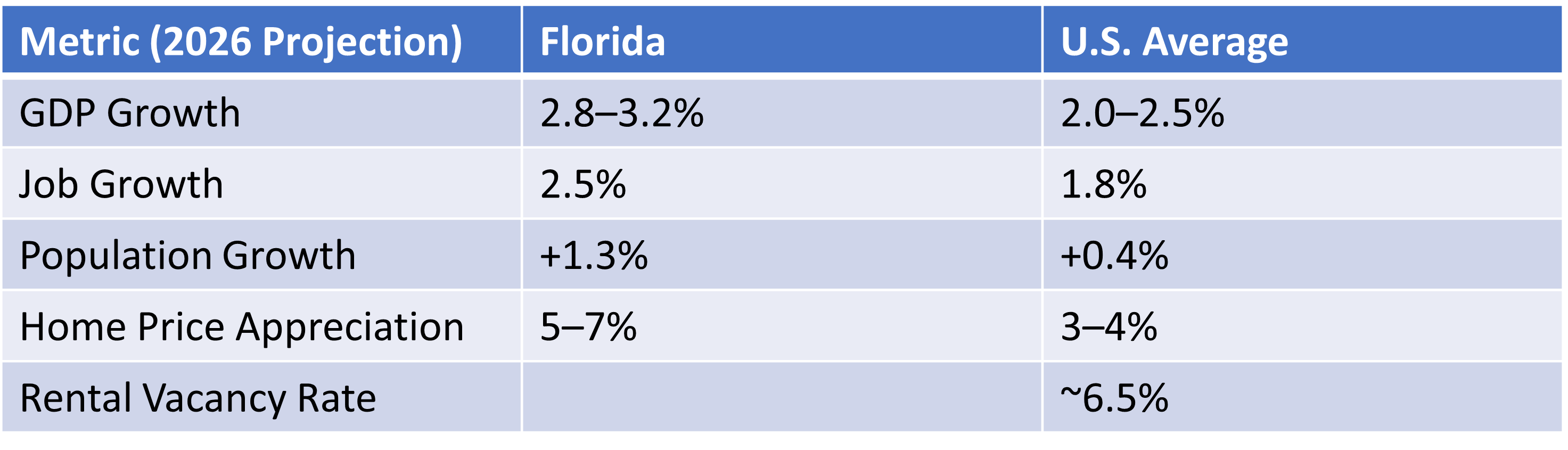
Florida consistently outpaces national averages, reinforcing its position as a top destination for investment, relocation, and real estate growth.
Implications for Homebuyers, Investors, and Mortgage Consumers
Homebuyers: Rising prices mean acting early is critical to secure affordable financing and build equity.
Investors: Strong rental demand and appreciation create opportunities in both single-family and multifamily properties.
Mortgage Consumers: Stabilizing interest rates in mid-2026 will improve affordability, making it an opportune time to refinance or purchase.
Business Owners: Florida’s expanding economy offers fertile ground for expansion, particularly in logistics, hospitality, and financial services.
Conclusion and Call to Action
Florida’s economy in 2026 is set to outperform the nation, driven by job growth, migration, corporate investment, housing demand, and tourism. For those considering real estate or mortgage decisions, the message is clear: early action in strong markets pays off.
If you’re evaluating homeownership, exploring investment opportunities, or considering mortgage financing, now is the time to position yourself ahead of the curve. Speak with a trusted real estate or mortgage professional to leverage Florida’s economic strength for your financial future.