
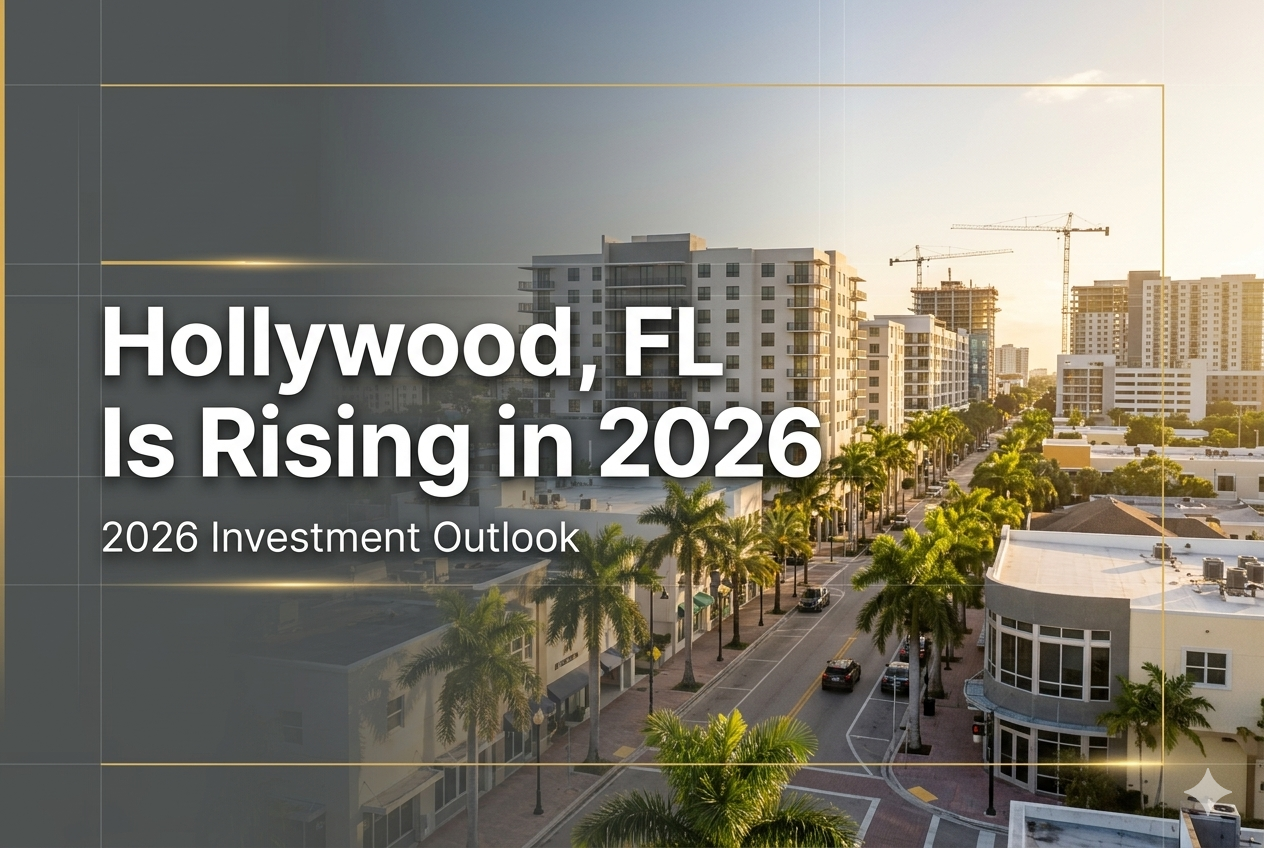
For decades, the South Florida commercial real estate narrative was dominated by the high-octane growth of Miami and the established corporate landscape of Fort Lauderdale. However, in 2026, the market center of gravity has shifted. Investors, developers, and institutional entities are increasingly focusing on the City of Hollywood as the premier destination for strategic capital placement.
This shift is not accidental. It is the result of deliberate urban planning, aggressive infrastructure investment, and a geographic advantage that is becoming impossible to ignore as secondary markets in the region reach saturation.
A Market Emerging Between Two Powerhouses
Hollywood is no longer viewed simply as a pass-through between Miami-Dade and Broward counties. It has emerged as a primary strategic hub. As costs in Miami reach historic peaks, businesses are seeking locations that offer the same connectivity without the prohibitive overhead.
The city’s position provides immediate access to two international airports and two major seaports, making it a logistical cornerstone for Florida businesses. Based on trusted industry reports, this "bridge" status has allowed Hollywood to capture a significant share of the business migration currently flowing into South Florida.
Billions in Investment Are Reshaping the City
The scale of transformation currently underway is historic. Recent development data indicates that Hollywood has secured over $2 billion in new investment and active development projects. This influx of capital is being funneled into a diverse pipeline that includes high-end hospitality, Class-A office space, and expansive mixed-use environments.
The city’s skyline and streetscape are being redefined by these projects. Unlike previous cycles that focused primarily on the beachfront, the current 2026 wave is penetrating the urban core and the western corridors, signaling a more comprehensive and sustainable expansion.
Public-Private Partnerships Driving Growth
A significant catalyst for this momentum is the city’s proactive stance on development. Through strategic public-private partnerships, Hollywood has effectively acted as a partner to the development community rather than a hurdle.
By streamlining the permitting process and providing clear frameworks for workforce and mixed-income housing, the city has attracted developers who specialize in long-term value creation. According to recent market data, these partnerships have been instrumental in launching transit-oriented projects that align with broader 2026 urban planning trends.
Strong Fundamentals Backing Demand
The interest in Hollywood is supported by rigorous data and strong market fundamentals. Investors are looking at a landscape defined by high absorption and a lack of available inventory.
Multifamily Vacancy: Rates remain consistently below 7%, signaling exceptionally strong absorption despite the influx of new supply.
Retail Expansion: More than 100,000 square feet of new retail space has been added in recent years to support a growing resident population.
Commercial Leasing: Office and industrial leasing activity has remained steady through 2026, driven by firms prioritizing infrastructure and labor access.
Residential Demand: A growing population base continues to put upward pressure on residential values, supporting the case for continued multifamily investment.
Why Businesses Are Paying Attention in 2026
For businesses evaluating their South Florida footprint, Hollywood offers a compelling value proposition. While Miami remains a global destination, the cost of doing business there has prompted many firms to seek efficiency. Hollywood provides a lower cost of entry while maintaining a high quality of life for the workforce.
Infrastructure and connectivity remain top priorities for firms in 2026. Hollywood’s proximity to major arterial highways and rail lines makes it an ideal location for companies that require seamless movement of goods and talent across the tri-county area.
A Shift Toward Mixed-Use and Walkable Development
One of the most notable trends in 2026 is the transformation of Downtown Hollywood into a walkable, live-work-play environment. Transit-oriented development is at the forefront of this change, with new projects designed to reduce car dependency and increase urban activation.
This shift toward experiential real estate is attracting a younger, highly skilled demographic. Developers are responding by creating environments that blend residential units with modern workspaces and curated retail, creating a 24-hour ecosystem that was previously absent from the market.
What This Means for Investors and Developers
For those looking to deploy capital in South Florida, the opportunities in Hollywood are varied. The multifamily sector continues to be a primary target, particularly workforce housing which addresses a critical need in the regional economy.
Retail and mixed-use projects also present significant upside as the density of the city increases. However, timing and positioning are critical. As institutional interest grows, the competition for prime sites is intensifying, making sophisticated market intelligence more valuable than ever.
Outlook for 2026 and Beyond
The investment momentum in Hollywood shows no signs of decelerating. Continued institutional interest suggests that the city is in the middle of a multi-year urban transformation. As infrastructure projects completed in 2025 and 2026 begin to fully integrate into the city’s fabric, the long-term growth trajectory remains highly favorable.
Hollywood has successfully shed its reputation as a secondary market and has cemented its status as a core investment destination in the South Florida landscape. For developers and businesses, the window for early-mover advantage is closing, and the focus is now on executing high-quality projects that can meet the demands of a sophisticated 2026 audience.