

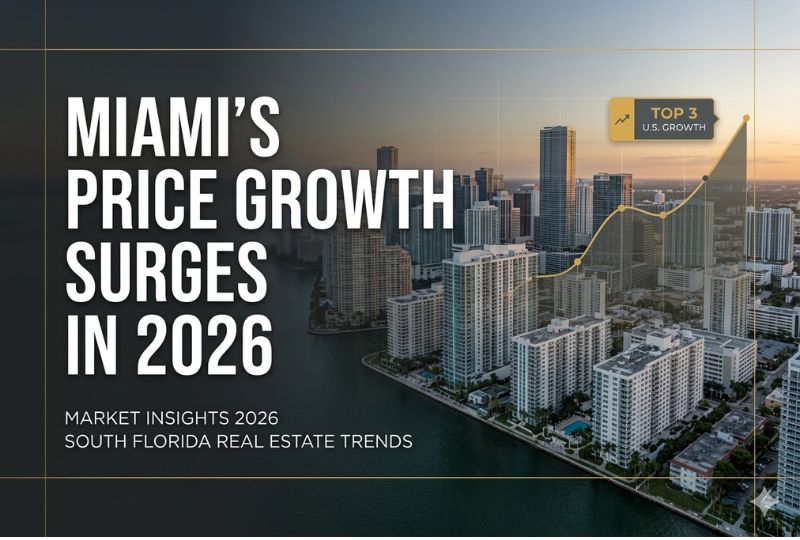
The South Florida housing market has entered a new phase of maturity in 2026. While much of the United States grapples with stagnation or corrected valuations, Miami has solidified its position as a national leader. Recent pricing trends indicate that Miami has climbed to 3rd place in monthly home price growth among the top U.S. metropolitan areas in early 2026.
This performance signals a significant departure from the volatile spikes seen earlier in the decade. Instead, the market is demonstrating a resilient, data-driven appreciation that reflects strong underlying fundamentals and a persistent imbalance between supply and demand.
Key Data Behind Miami’s Price Growth
The early 2026 data reflects a market that is stabilizing at a high plateau. According to recent housing data, the metrics for the Miami metropolitan area include:
Monthly Growth Rate: Monthly price appreciation is currently tracking between 0.8% and 1.2% in leading sectors.
Annual Appreciation: Year-over-year growth has moderated to a sustainable 3% to 5% range, reflecting market stabilization.
Median Home Prices: The median price for a single-family home in Miami now sits within the $600,000 to $650,000 range.
Inventory Levels: Housing supply remains at historically low levels, with the months of inventory significantly below the national average.
What’s Driving Continued Demand in 2026
The primary engine behind Miami’s price growth is the sustained influx of new residents. Based on trusted market reports, domestic migration from high-tax states in the Northeast and Midwest remains a dominant force. These are often high-income buyers who view Miami’s pricing as competitive compared to markets like New York or San Francisco.
Furthermore, international demand has surged back to pre-pandemic levels. Investors from Latin America and Europe continue to view South Florida real estate as a safe-haven asset for capital preservation. When combined with the ongoing wealth migration and the city’s favorable tax climate, the demand side of the equation remains exceptionally robust.
Supply Constraints Are Supporting Prices
While demand is high, the supply side is where the market faces its greatest challenges. Supply constraints are a major factor supporting the current price trajectory. New construction has consistently failed to keep pace with the number of new households entering the region.
Several factors contribute to this persistent deficit:
Zoning and Land Limitations: Much of the available land in the urban core has already been developed, leading to increased competition for remaining sites.
Development Challenges: Higher costs for materials and specialized labor continue to impact the delivery timelines for new projects.
Slow Delivery: The pipeline for new housing, particularly for entry-level and mid-market units, remains insufficient to meet current absorption rates.
How Mortgage Rates Are Influencing the Market
The interest rate environment in 2026 has provided a level of predictability that was missing in previous years. Recent lending data shows that mortgage rates have stabilized around the 6% to 6.5% range.
This stabilization has helped buyers adjust their behavior. While the era of 3% rates is in the past, the current environment has removed the "wait and see" approach that many buyers adopted during the period of rapid rate hikes. Buyers in 2026 are making decisions based on long-term lifestyle and investment goals, accepting the current rate environment as the new normal for the foreseeable future.
Implications for Investors and Developers
For institutional investors and developers, Miami’s price resilience offers a compelling case for continued allocation. The steady monthly growth suggests that the market is not in a bubble, but is instead undergoing a fundamental repricing.
Opportunities remain particularly strong in several sub-sectors:
Multifamily: The demand for high-quality rental units continues to grow as the barrier to entry for homeownership increases.
Luxury Condos: The high-income buyer influx maintains strong absorption rates for premium vertical developments.
Workforce Housing: The rising median home price has created a critical need for housing that serves the local labor force, offering a unique opportunity for developers who can navigate the complexities of middle-market delivery.
Miami vs Other Major U.S. Markets
When compared to other major metros, Miami is currently outperforming many of its traditional rivals. While markets in Texas and the Southeast have historically competed for the same pool of domestic migrants, Miami’s unique combination of global connectivity and limited geographic expansion space gives it a distinct advantage. Recent pricing trends indicate that while Texas markets have seen more inventory hit the market, Miami’s inventory remains tightly held, fueling the 3rd place ranking in monthly growth.
Outlook for 2026 and Beyond
The outlook for the remainder of 2026 and into 2027 is one of slower but steady growth. The era of double-digit annual spikes has transitioned into a period of sustainable appreciation. This is a healthy development for the long-term viability of the South Florida real estate market.
With strong long-term fundamentals, including a growing professional base and continued international appeal, Miami is well-positioned to maintain its status as a top-performing U.S. market. For those looking to deploy capital, the data suggests that Miami remains a primary destination for growth and stability in an uncertain global economy.