
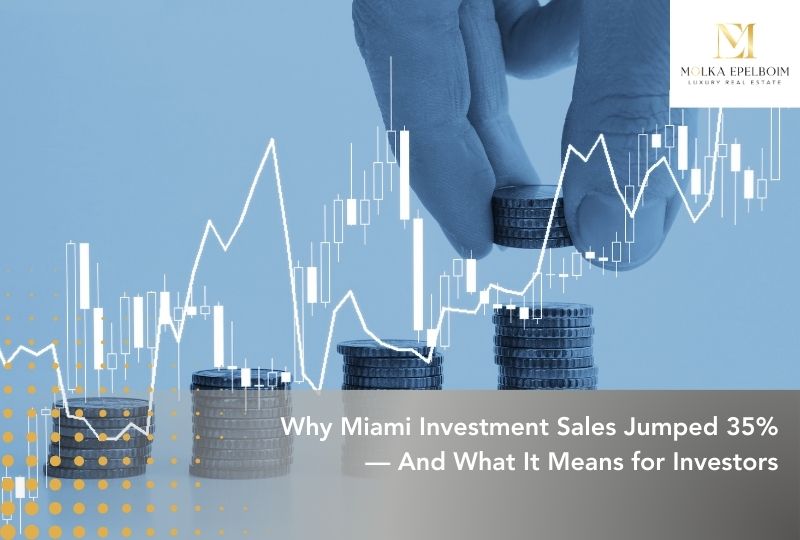
Miami’s commercial real estate market has roared back to life, with investment sales jumping 35% year-over-year in 2025 as investors return from the sidelines. After a period of caution driven by rising interest rates and global uncertainty, capital is flowing back into Miami across multifamily, industrial, retail, and select office assets. This resurgence signals renewed confidence in Miami as one of the premier real estate investment destinations in the U.S.
Why Investors Paused — And What Changed
Interest Rate Volatility
Throughout 2023–2024, aggressive Federal Reserve rate hikes pushed borrowing costs to their highest levels in decades. Many investors adopted a “wait-and-see” approach, delaying acquisitions until financing conditions stabilized. By late 2025, however, the 10-year Treasury yield leveled near 3.9% and mortgage rates began to stabilize around 6.7%, creating more predictable underwriting environments .
Capital Preservation
Institutional investors shifted capital into safer, stabilized assets during the uncertainty. Now, with inflation cooling and liquidity improving, capital is re-entering growth markets like Miami, where fundamentals remain strong.
Drivers of Investor Confidence in Miami
Population Growth and Migration Trends
Florida continues to lead the nation in net migration. Miami-Dade alone added over 40,000 residents in 2025, fueled by domestic relocations and international inflows. This demographic expansion underpins demand for housing, retail, and services .
Strong Rental Demand
Multifamily assets remain the cornerstone of Miami’s investment market. Vacancy rates hover near 3.8%, well below the national average, while rents grew 6.2% annually in 2025. Investors are targeting Class A and Class B properties, confident that rental demand will remain resilient.
International Capital Inflows
Miami’s global appeal continues to attract foreign investors, particularly from Latin America and Europe. Currency diversification, political stability, and Miami’s role as a gateway city make it a preferred destination. Reports from Cushman & Wakefield highlight increased cross-border capital targeting Miami’s prime assets in late 2025 .
Industrial and Logistics Expansion
Industrial real estate has surged, with 1.2 million square feet of new inventory delivered in Q4 2025, nearly double the prior quarter. Vacancy remains tight at under 4%, driven by e-commerce growth and Miami’s strategic role as a logistics hub for Latin America.
Asset Class Breakdown
Multifamily
Most active sector in Miami investment sales.
Strong rent growth and low vacancy attract institutional and private equity capital.
Workforce housing remains a priority, given affordability challenges.
Office
Prime Class A assets in Brickell and Downtown Miami continue to draw corporate tenants and investors.
Secondary office markets face challenges, with higher vacancy and slower leasing activity.
Hybrid work trends are reshaping demand, but trophy assets remain resilient.
Retail
Experiential and neighborhood retail centers are outperforming traditional malls.
Investor focus is on grocery-anchored and lifestyle centers, supported by population growth.
Industrial
Miami’s industrial market is one of the fastest-growing in the Southeast.
Logistics, cold storage, and last-mile facilities are in high demand.
Institutional investors are aggressively pursuing acquisitions in this sector.
What This Means for Domestic and International Investors
Domestic Investors
U.S. institutional capital is re-entering Miami, targeting stabilized multifamily and industrial assets.
Private investors are increasingly active in retail and mixed-use developments.
The 35% jump in sales volume reflects renewed confidence in Miami’s fundamentals.
International Investors
Miami remains a safe haven for global capital.
Latin American investors continue to dominate cross-border activity, while European funds are expanding exposure.
Currency diversification and Miami’s global connectivity make it a long-term play.
Outlook for 2026
Sales volume is expected to remain elevated, with multifamily and industrial leading activity.
Office recovery will be selective, favoring prime assets in core submarkets.
Retail will benefit from population growth and lifestyle-driven demand.
International capital inflows will continue, reinforcing Miami’s position as a global investment hub.
Conclusion
Miami’s 35% surge in investment sales underscores the city’s resilience and attractiveness as a commercial real estate market. Stabilized interest rates, strong rental demand, industrial expansion, and international capital inflows are driving renewed investor confidence. For both domestic and international investors, Miami offers a compelling mix of growth, stability, and global connectivity—cementing its role as one of the most dynamic real estate investment markets in the U.S.